WiTricity - Experts & Thought Leaders

Latest WiTricity news & announcements
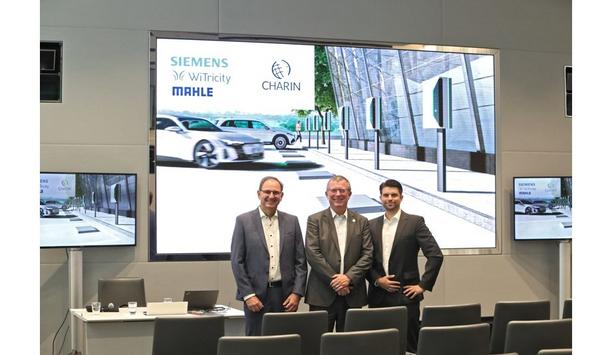
CharIN launches a Wireless Power Transfer Taskforce initiated by Siemens AG, WiTricity Corporation, and MAHLE. The Taskforce aims to drive the adoption and standardization of wireless charging solutions for electric vehicles worldwide to enable seamless wireless charging experiences. Industry experts are invited to participate. The Taskforce will start in September. Wireless Power Transfer Taskforce The founding of the Wireless Power Transfer Taskforce stems from the need to enable seamless wireless charging solutions for electric vehicles. Currently, there are remaining gaps in standardization that pose challenges to vehicle OEMs and the imminent deployment of wireless charging. The CharIN Taskforce, initiated by Siemens AG, WiTricity Corporation, and MAHLE, seeks to close these gaps in a timely manner, ensuring the successful integration and utilization of wireless power transfer technology in the evolving electric mobility landscape. Cohesive ecosystem Taskforce aims to create a foundation for seamless, efficient, and universal wireless charging solutions The Taskforce will actively work towards harmonizing standards in wireless power transfer (WPT) technology for charging vehicles, while focusing on a static 11 kW charging system. By resolving open points in existing WPT standards, the Taskforce aims to create a foundation for seamless, efficient, and universal wireless charging solutions. Defining the respective applicability of wireless charging will play a crucial role in its integration into diverse EV platforms. By defining rigorous test procedures and certification guidelines for interoperability, the Taskforce aims to ensure that wireless charging solutions are reliable, efficient, and compatible across different platforms. Additionally, the Taskforce will focus on clearing the co-existence of relevant technologies for wireless power transfer, fostering a cohesive ecosystem for the future of EV charging. Future of wireless technology "Through the establishment of our new CharIN Taskforce, we pave the way for a new era of smart charging. By sharing knowledge and fostering collaboration, we propel the seamless integration of wireless charging solutions, energizing the future of EVs worldwide," Claas Bracklo, Chairman of CharIN e.V. "We initiated this Taskforce to make convenient wireless charging available to end customers very soon," said Thomas Wuerz, Taskforce Lead (Siemens AG). The Taskforce invites both CharIN members and non-members to participate actively in shaping the future of wireless charging technology. Companies interested in joining the Taskforce can register their interest.
Siemens has invested US$ 25 million and acquired a minority stake in U.S.-based WiTricity, a wireless charging technology firm. Siemens and WiTricity will work together to drive innovation in the emerging market for wireless EV charging. This market is expected to reach USD 2 billion by 2028 in Europe and North America alone, according to Siemens’ calculations. Siemens and WiTricity partnership The two companies seek to bridge the gaps in the global standardization of wireless charging for electric passenger and light duty commercial vehicles, in order to enable interoperability between vehicles and infrastructure, as well as support market penetration. In addition, both parties will collaborate to advance the technical development of wireless charging systems. Markus Mildner, the Chief Executive Officer (CEO) of Siemens eMobility, said “Combining Siemens’ global footprint and EV charging portfolio with WiTricity’s innovative technology is the first step towards elevating our offering in the wireless charging space.” Speeding up deployment of wireless charging technology Siemens will also become a technology license partner, benefitting from WiTricity’s deep know-how Markus Mildner adds, “This will speed up deployment of wireless charging technology, support standardization, and advance public charging infrastructure with interoperable solutions for drivers’ convenience.” Siemens will also become a technology license partner, benefitting from WiTricity’s deep know-how and decade-long collaboration with global automotive OEMs to develop proven, field-tested, interoperable wireless charging solutions. Innovative and proven technology A charging pad mounted on or in the ground exchanges power with a receiving coil attached on the underside of the EV. There are no moving parts or physical connectors. Instead, a magnetic field transfers energy between the charging pad and the vehicle coil when the vehicle is over the charging pad. The system uses resonant induction between the charger and receiver, in order to provide high efficiency at a variety of ground clearances, from low-slung sports cars to SUVs. Cost effective and global availability The ultimate goal of the Siemens and WiTricity collaboration is to accelerate the maturing of wireless charging technologies together with OEMs and infrastructure partners, to simultaneously ensure their cost-effective availability worldwide. A recent survey of more than 1,000 current and future EV owners who are interested in purchasing an EV in the next two years indicated that wireless charging was one of the highest rated add-ons and a more preferred option to other amenities, including park-assist, performance, or premium audio packages. Wireless charging makes EVs more appealing Siemens and WiTricity share the goal of improving EV ownership and fleet management" Alex Gruzen, the Chief Executive Officer (CEO) of WiTricity, said “Wireless charging enables a driver to just park and walk away, returning to a charged vehicle. Wireless charging makes EVs more appealing for individual owners and more cost effective for commercial operators. We are excited to partner with a leader like Siemens to help drive this new world of compelling solutions.” Alex Gruzen adds, “Siemens and WiTricity share the goal of improving EV ownership and fleet management, with the matchless simplicity and reliability of wireless charging.” Eliminating autonomous vehicle friction points For autonomous vehicles to fulfill their promise, key friction points will need to be removed, such as charging, which currently still requires human intervention. Wireless power transfer will be the key technology to enable contactless automatic charging with least maintenance requirements and pave the way to an all-electric, fully autonomous mobility future.