Contactors are electromechanical switches used to control electrical power circuits and are essential in industrial applications due to their ability to handle high currents. Unlike manual switches, contactors can be operated remotely.
Their primary function is to control electric motors, but they are also used in lighting, heating, capacitor banks, and other electrical load applications.
Understanding Reversing Contactors
In industrial automation, managing the direction of electric motors is crucial for various operations. Reversing contactors facilitate this control by allowing the direction of a three-phase AC motor to be changed. This is achieved by integrating two standard contactors with a mechanical interlock unit, ensuring that both are not engaged simultaneously.
When one contactor is activated, the motor operates in the forward direction; activating the other reverses the motor’s direction. This configuration is vital for applications requiring frequent and reliable changes in motor direction.
Reversing vs. Non-Reversing Contactors
The main contrast between reversing and non-reversing contactors lies in their design and functionality
The main distinction between reversing and non-reversing contactors lies in their design and functionality. Non-reversing contactors control motor operation in a singular forward direction.
In contrast, reversing contactors use two interlocked contactors to swap two of the three-phase power lines, allowing for directional change.
Both types offer motor protection, but reversing contactors add the capability of directional control, making them suitable for controlling systems such as conveyor belts, pumps, and elevators.
NOARK's Ex9CR and Ex9CSR Series
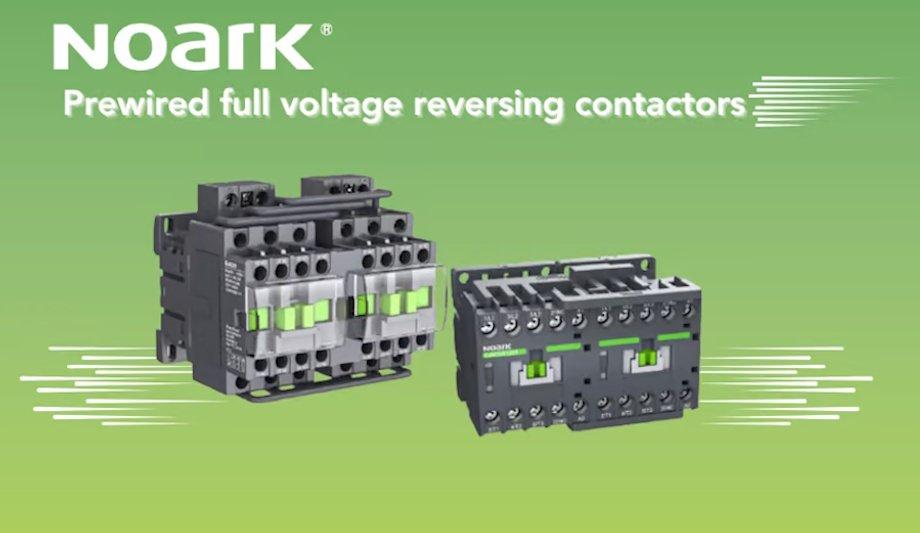
NOARK Electric introduces the Ex9CR Series Standard IEC Reversing Contactor and Ex9CSR Series Reversing Mini Contactor, designed for demanding forward/reverse operations of three-phase AC motors. These assemblies are connected by electrical and mechanical interlocks, ensuring only one contactor is closed at any time.
Offering reliability with an extended mechanical and electrical lifespan, these series suit inductive motor applications, providing configurations from 9A to 500A (standard reversing) and 6A to 12A (mini reversing) full-load amps.
Compact Design and Installation Flexibility
NOARK provides a 5-year limited warranty with the Ex9CR and Ex9CSR series
The compact design of the Ex9CR and Ex9CSR series makes them ideal for installations where space is limited. They can be mounted on panels with screws or attached using DIN-rails, offering flexibility.
Compliant with international standards such as IEC, UL, and CSA, these contactors ensure safety and performance. NOARK provides a 5-year limited warranty with the Ex9CR and Ex9CSR series.
Enhancing Functionality with Accessories
The Ex9CR and Ex9CSR come with a range of accessories to enhance functionality, including front and side mount auxiliary contacts, mechanical interlocks, surge suppressors, and a reversing kit.
They feature a wide-range electronic coil with built-in surge suppression, distinguishing them from competitors. This robust design and accessory availability advocate for integrating NOARK's contactors into operations to ensure effective and safe motor control.
A contactor is an electromechanical switch used to switch an electrical power circuit. Unlike manual switches, contactors can be handled remotely and are developed to handle high currents, making them essential in many industrial applications.
Their most common application involves control of electric motors. Other applications include lighting, heating, capacitor banks, and other electrical loads.
In the world of industrial automation, overseeing the direction of electric motors is necessary for various applications. Reversing contactors is key to achieving this control and ensuring that machinery operates efficiently and safely.
What is a Reversing Contactor?
A reversing contactor is a specialized assembly that allows the direction of a three-phase AC motor to be changed. This is achieved by combining two standard contactors with a mechanical interlock unit, ensuring that both contactors cannot be engaged at the same time.
When one contactor is energized, the motor runs in the forward direction; when the other is energized, the motor comes to a halt and runs in the reverse direction. This setup is essential for frequent and reliable forward and reverse motor operation or direction switching applications.
Difference Between Reversing and Non-Reversing Contactors
The primary difference between reversing and non-reversing contactors lies in their configuration and functionality. The non-reversing contactor controls the motor in a single (forward) direction.
In contrast, a reversing contactor uses two interlocked contactors to change the motor’s direction by swapping/interchanging two of the three-phase power lines.
In this case, the connection on the load side would be phase L1 to L3, L2 to L2, and L3 to L1, as seen in the diagram. Both configurations offer similar safeguards regarding motor protection, but reversing contactors provide the added functionality of directional control.
Applications for Reversing Contactors
Reversing contactors are being used in several industrial applications for controlling/changing the directions of conveyor systems, pumps, elevators, cranes, and other industrial machinery.
Introducing NOARK’s Ex9CR and Ex9CSR Series
NOARK Electric offers Ex9CR Series Standard IEC Reversing Contactor and Ex9CSR Series Reversing Mini Contactor designed for demanding forward/reverse operations of three-phase AC motors.
These are multi-contactor assembly connected by an electrical and mechanical interlock that ensures only one contactor closes at a time.
They are available in various ratings and are suitable for inductive motor applications from 9A to 500A (standard reversing) and 6A to 12A (mini reversing) full-load amps.
Ex9CR and Ex9CSR compact design
They can be panel-mounted with screws or DIN-rail mounted, providing installation flexibility. This series offers high reliability with extended mechanical and electrical life.
The Ex9CR and Ex9CSR compact design make them ideal for applications where space is limited. They are compliant with international standards such as IEC, UL ,and CSA, ensuring safety and performance. Like most NOARK products, the Ex9CR and Ex9CSR series have a 5-year limited warranty.
Range of accessories to enhance functionality
The Ex9CR and Ex9CSR series offer a range of accessories to enhance functionality, which include: –
1. Front and Side Mount Auxiliary contacts
2. Mechanical Interlocks
3. Surge Suppressors
4. Reversing kit
Range electronic coil with built-in surge suppression
In comparison to alternatives from competitors, the Ex9CR and Ex9CSR series stand out due to their compact design, a wide-range electronic coil with built-in surge suppression, and comprehensive accessory options.
The 5-year limited warranty further underscores NOARK’s commitment to quality and customer satisfaction.
More About NOARK’s Reversing Contactors
Now that they understand the importance and applications of reversing contactors, consider integrating NOARK’s Ex9CR Series 9A to 500A Standard IEC Reversing Contactor and Ex9CSR Series 6A to 12A Reversing Mini Contactor into the operations for efficient and safe motor control.