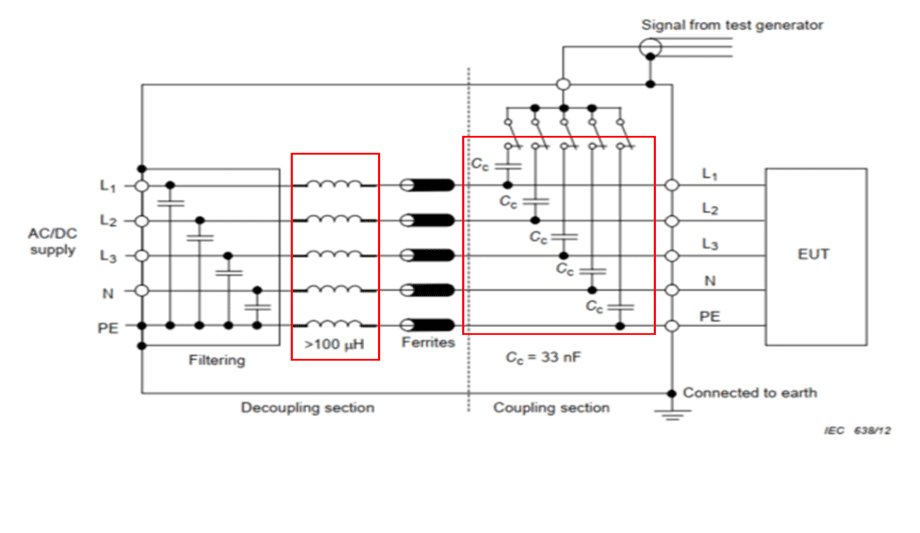
Just in case achieving a pass during EFT testing wasn’t tricky enough, how about throwing in an additional hurdle…the added inductance and capacitance the transient generator CDN applies to the DC power lines.
A customer provided them with the opportunity to debug an EFT issue seen during the original round of testing at another laboratory. The failure mode was pretty obvious and a real showstopper, the EUT will crash/ lock up/ stop functioning and a full power off and on cycle is required to establish a normal operating condition.
Providing valuable information
Sure enough, on arrival at Unit 3 Compliance the failure mode was repeated, however, the failure immediately stood out as being a little odd because it occurred before the actual EFT test had begun.
This was certainly a new phenomenon for them and something they haven’t encountered before. The failure certainly didn’t feel like a proper EFT failure and something else was afoot. To figure out what is changing during the generators initialization stage EN61000-4-4:2012, section 6.3.1 provides some valuable information and defines the internal make up of the EFT generator.
Small input capacitance
The capacitors don’t care where the energy comes from, they just want charging right now
The 33nF capacitors are switched into the circuit as soon as the “start test” button is pressed on the transient generator; this is the very first thing the generator does during its initialization stage, before any transients are applied. Charging of the added capacitance requires a gulp of energy that must be sourced from either the DC power supply or the EUT. The capacitors don’t care where the energy comes from, they just want charging right now.
So, what’s the best source of energy? The DC power supply would be great, however, energy is going to be supplied relatively slowly because of the >100uH inductors in the decoupling section, so that leaves the EUT to supply the energy. If the EUT only has a small input capacitance then this will cause a drop in voltage across the input of the EUT. If the EUT has some kind of Under Voltage Lock Out (UVLO) circuit then there’s a very good chance the equipment will fall over in some fashion!
Real world installation
At first glance this failure will present itself as an EFT issue, but this failure wasn’t caused by a transient voltage.
Adding sufficient de-coupling capacitance at the input of the EUT provided a good enough reservoir of charge that can be consumed in this test situation. More importantly it isn’t beyond the realms of possibility that the EUT will face a real world installation that is similar to that of the EFT test set up (long, inductive power supply lines), so having sufficient de-coupling will go some way to help with the smooth installation and compatibility of the EUT. With the larger capacitance in place they tested this EUT up to 2kV (against a specification of 1kV) and it performed fine.